










Can a Cargo eBike Replace Your Second Car?

For many families, the idea sounds radical at first:
Replace a car… with a bike?
But across cities in the U.S. and Europe, more households are quietly doing exactly that—not by giving up driving entirely, but by replacing the second car with a cargo eBike that handles school runs, errands, and daily logistics.
And once families try it, many discover it’s not a compromise. It’s an upgrade.
The Reality of the “Second Car” in Most Families
The second car often exists for short, repetitive trips:
-
School drop-offs
-
Grocery runs
-
After-school activities
-
Local commuting
-
Weekend errands
These trips are typically under 10 miles, happen in traffic-heavy areas, and involve the biggest headaches of driving: congestion, parking, and cost.
Research shows cargo bikes are especially suited for transporting children and goods—two of the strongest reasons people rely on cars.
School Drop-Off: Where Cargo Bikes Win Immediately
One of the most consistent themes parents mention is how dramatically the school run changes.
“There's no better feeling… than zipping by a long line of queued up cars at dropoff.”
Parents aren’t just saving time—they’re escaping the stress loop of:
idle → queue → park → unload → repeat
Another rider noted their commute by car could take 19 minutes—
but in traffic it stretched to nearly an hour, while the bike trip stayed a predictable 35 minutes every day.
That reliability is something cars often can’t deliver in urban environments.

Traffic Changes the Math—Not Speed, But Consistency
Cargo eBikes don’t always beat cars in top speed.
They win in time certainty.
Urban studies show cargo bikes maintain steady travel speeds even in dense city conditions where vans slow significantly due to congestion.
That means:
-
No traffic jams
-
No circling for parking
-
No unpredictable delays
Just a repeatable door-to-door routine.
Parking: The Hidden Time (and Money) Drain
Parking is one of the biggest inefficiencies of car-based errands.
In delivery comparisons, vans may spend up to 25 minutes searching for parking, while cargo bikes can stop within meters of their destination.
Families feel this every day:
-
No hunting for a space
-
No parking fees
-
No walking across giant lots with kids
-
No “just running in for one thing” turning into 20 minutes
You arrive. You stop. You're done.
The Financial Case Is Stronger Than Most Expect
Owning a second car is expensive—even when it’s barely used.
Studies comparing cargo bikes to vans found they can be:
-
Twice as energy-efficient
-
Over ten times cheaper to operate in urban use cases
Lower costs come from eliminating:
-
Fuel
-
Insurance
-
Registration
-
Major maintenance
-
Depreciation
Even logistics operators—who measure every dollar—report cost reductions when replacing vehicle trips with cargo bikes.
Families Don’t Just Use Cargo Bikes—They Start Driving Less
This isn’t theoretical. Behavior actually changes.
Studies indicate that access to cargo bikes reduces reliance on cars and can even influence households to delay or avoid purchasing another vehicle.
In practice, the cargo bike doesn’t just replace trips—it reshapes how families think about transportation altogether.
What This Looks Like in Real Life
For families making the shift, the goal isn’t to eliminate cars entirely.
It’s about choosing a vehicle designed specifically for everyday family movement.
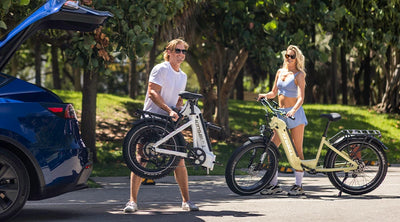
That’s where purpose-built cargo eBikes—like the Voyager 2.0 from KINGBULL—start to make a lot of sense for everyday routines.
Rather than adapting a standard bike with add-ons, this type of long-range cargo model is designed from the ground up to handle real household demands:
-
Carrying children safely and comfortably
-
Transporting groceries, school bags, or sports gear in one trip
-
Remaining stable and easy to control even when fully loaded
-
Providing extended range so multiple errands can be completed without worrying about recharging
In short, it functions less like a traditional bicycle—and more like a neighborhood-scale alternative to a second car.

Why Families Are Choosing This Type of Vehicle
When replacing a second car, households tend to prioritize three things:
1. Predictability
A cargo eBike delivers consistent travel time regardless of congestion.
2. Utility Without the Bulk
You can carry what you need without maneuvering a full-size vehicle through tight streets or school zones.
3. Lower Cost of Everyday Mobility
Quick errands no longer feel like something that requires starting a car and paying for it later.
This shift is less about cycling culture and more about matching transportation to real-life distances.
It’s Not Only Practical. It’s a Better Daily Experience
Many parents highlight something unexpected:
the ride becomes quality time instead of stressful time.
Families say they can actually talk with their kids during the ride rather than managing traffic and stress.
That emotional shift—from chore to connection—is hard to measure, but it’s mentioned again and again in real-world use.
What Cargo Bikes Do Best (and Where Cars Still Matter)
Cargo eBikes aren’t a universal replacement—and they don’t need to be.
They excel at:
✅ School drop-offs
✅ Short commutes
✅ Groceries and errands
✅ Dense urban travel
✅ Replacing high-cost “backup cars”
Cars still make sense for:
-
Long-distance travel
-
Severe weather days
-
Rural or infrastructure-limited areas
Even advocates say they keep one vehicle for those scenarios.
The Bigger Urban Impact
When scaled across cities, replacing car trips with cargo bikes reduces:
-
Congestion
-
Emissions
-
Noise
-
Space required for parking
In fact, 38–55% of cargo-bike trips would otherwise have been done by car, demonstrating real substitution potential.
That’s why many planners now see cargo bikes not as recreational tools—but as part of the transportation system.
So—Can a Cargo eBike Replace Your Second Car?
For many families, it already has.
Not because they wanted to “go car-free.”
But because for everyday life, the bike turned out to be:
-
Faster in real conditions
-
Easier to manage
-
Cheaper to own
-
More enjoyable to use
The second car often exists to solve small daily problems.
Cargo eBikes simply solve those problems more efficiently.
✔ Replace every car? Probably not.
✔ Replace the one that mostly runs errands? Very often, yes.


Leave a comment